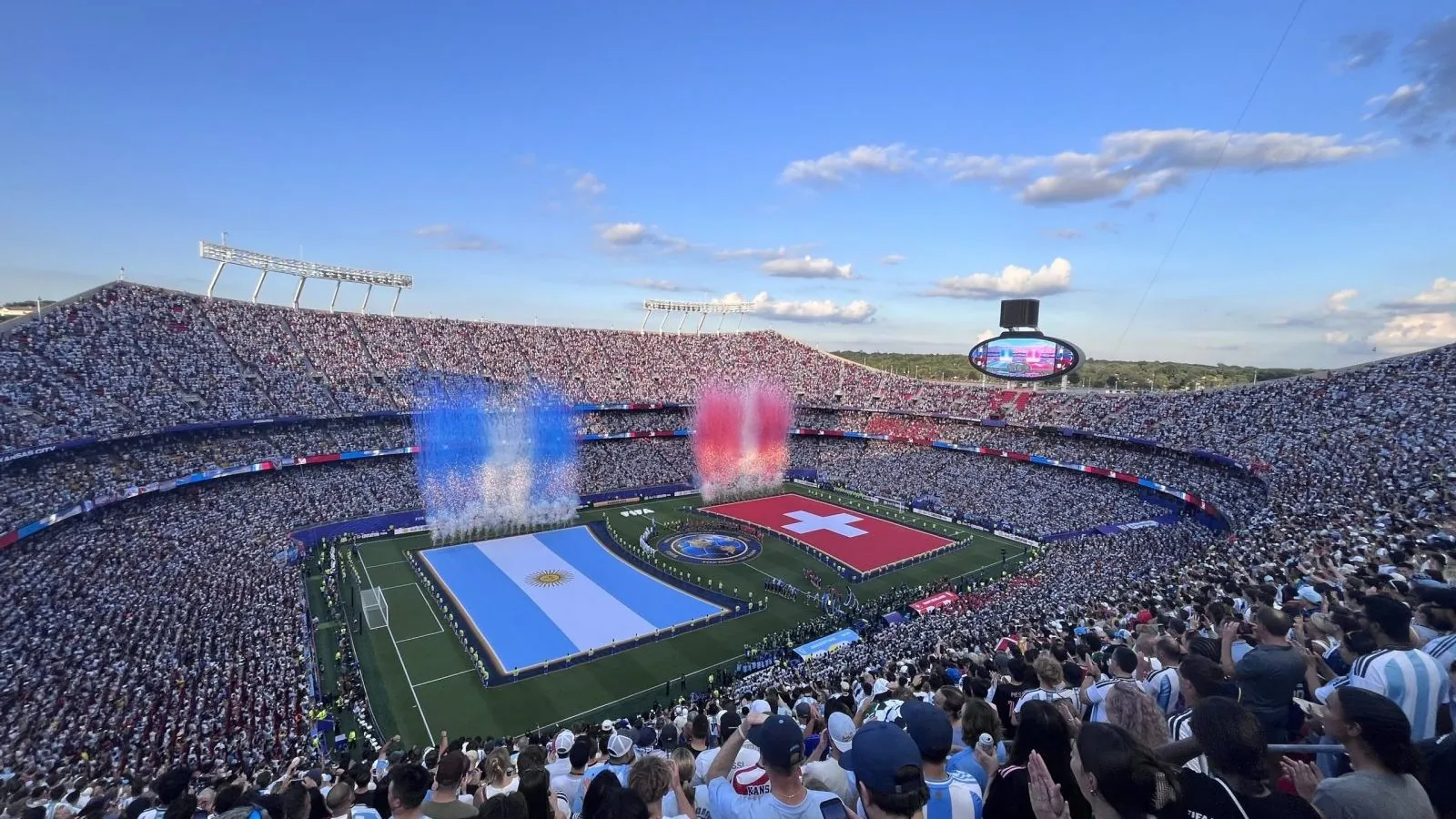
Julian Alvarez's 112th-minute strike carried Argentina past Switzerland and into the World Cup 2026 semi-finals after a 3-1 extra-time win in Kansas City. Alexis Mac Allister had given Argentina an early lead, Dan Ndoye levelled for Switzerland, and Lautaro Martinez added the third in stoppage time of extra time. FIFA's official tournament schedule lists the Match 100 fixture in Kansas City and the Atlanta semi-final route.
Read the wider context in France 2-0 Morocco: Mbappe and Dembele send France into Spain semi-final.
The scoreline says Argentina won by two goals, but the story was far less comfortable. Switzerland recovered from an early setback, took the quarter-final into extra time, and were still resisting until Alvarez found the finish that changed the tournament bracket.
Argentina lead, Switzerland answer
Mac Allister opened the scoring in the 10th minute, heading in Lionel Messi's corner. Argentina had an early platform, but they did not turn it into a quiet route to the semi-finals. Switzerland stayed in the contest and made the second half increasingly awkward for the holders.
Ndoye equalised in the 67th minute after Switzerland built pressure down the left. The goal reset the tie and gave the quarter-final a different rhythm: Argentina were no longer defending a lead, while Switzerland had proof that their route through the competition could continue.
That response matters more than a generic note that the game was close. Switzerland had reached the last eight after eliminating Colombia on penalties, and their equaliser put the defending champions under a level of knockout pressure that the early Mac Allister goal had appeared to remove.
The balance changes before extra time
Switzerland's task became harder when Breel Embolo was sent off after a second yellow card following a VAR review. The dismissal came shortly after Ndoye's equaliser and left Switzerland to manage the rest of normal time and extra time with 10 players.
Argentina had more of the responsibility from that point. A numerical advantage does not automatically create a winner, especially in a tournament quarter-final where the remaining side can defend deeply and wait for penalties. Switzerland kept the score at 1-1 through 90 minutes and the first half of extra time, making the next goal the central question of the match.
Alvarez finds the semi-final moment
Alvarez answered it in the 112th minute, cutting inside and scoring from distance to put Argentina 2-1 ahead. It was the result's defining action because it ended a long period in which Argentina had been unable to restore their lead despite the extra player.
Martinez's finish at 120+1 made the final score 3-1, but Alvarez's goal was the moment that broke Switzerland's resistance. Argentina had gone from a draw that pointed towards penalties to a late two-goal margin, while Switzerland's World Cup ended after an effort that had taken the holders beyond 90 minutes.
The article does not need to invent broader claims about control or momentum. The confirmed sequence already gives it a clear shape: an early Argentina lead, a Switzerland response, a red card, and an extra-time intervention from Alvarez.
England await in Atlanta
England are next in Atlanta on 15 July after their own 2-1 extra-time win over Norway. Both semi-finalists therefore arrive from quarter-finals that required more than 90 minutes, but the immediate task is now simple: Argentina have a final place at stake against England.
For Argentina, the Switzerland win is a survival result as much as a scoreline. They found a way through a tie that had moved away from them in normal time, then used Alvarez's strike to turn pressure into a semi-final. England will bring a new challenge; Kansas City is the reason Argentina are still in the tournament.