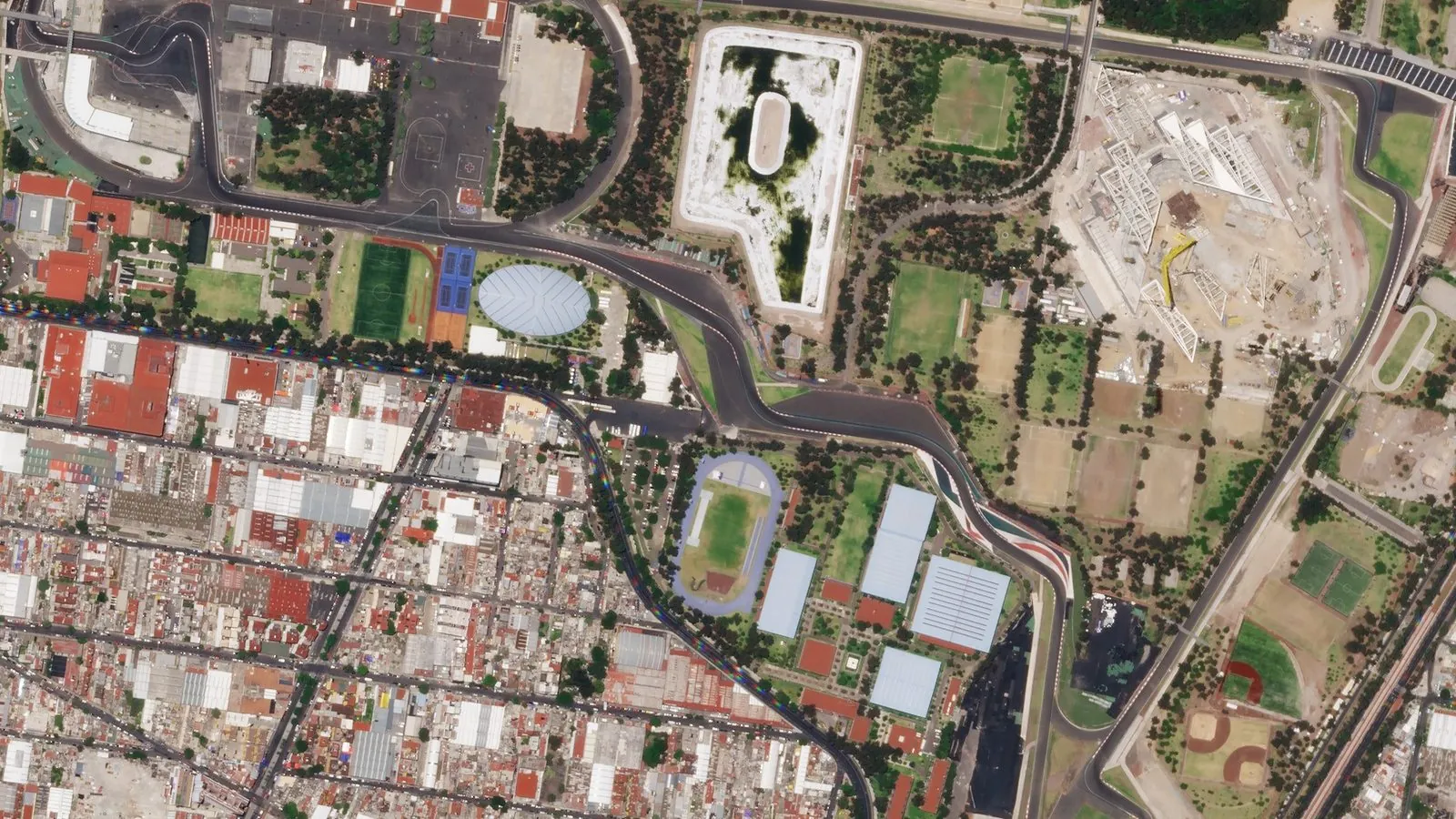
The 2026 Mexico City Grand Prix runs from 30 October to 1 November at the Autódromo Hermanos Rodríguez. Alpine’s official preview published on 27 October places the circuit above 2,200 metres and explains that the thinner air reduces both downforce and drag. That creates a useful fan question: why can teams use high-downforce settings and still reach unusually high straight-line speeds?
A standard-atmosphere calculation gives the scale of the change. NASA’s reference table lists air-density values by altitude, while NASA’s lift and drag equations show density alongside speed, area and the aerodynamic coefficient. Using 2,200 metres as a round reference, then interpolating between the table’s 7,000- and 8,000-foot entries, puts density at about 80.5% of its sea-level reference value, or roughly one-fifth lower.
Why high downforce and high speed can coexist
In a simplified comparison, keep the car, speed, wing setting and aerodynamic coefficient unchanged. If a car produced 100 units of aerodynamic force at the sea-level reference density, the same equation gives about 81 units at the Mexico City reference density. The figure is a worked example, not a measurement of an F1 car and not a forecast for this weekend. Actual cars use different shapes and setups, and their aerodynamic coefficients change with configuration and airflow.
Density is only one term in the lift and drag equations. Area, speed and aerodynamic coefficients matter too, and setup changes alter those coefficients. So the 80.5% reference ratio does not say a modern F1 car loses exactly 19.5% of its actual downforce. It describes a controlled comparison with every other input held steady, not a measured setup value.
Alpine says teams have traditionally used high-downforce packages in Mexico despite the circuit’s 1.2-kilometre main straight, and that lower air resistance still permits some of the season’s highest speeds. The straight and the stadium section ask different questions of the same car. A speed-trap number alone therefore cannot tell a fan whether a team has chosen a low-drag setup or how much grip it has through the corners. Formula 1’s circuit guide also places pole position about 830 metres from the Turn 1 braking point, a run where a following car can use a tow. That is useful context, not a guarantee of an overtake: a tow changes the air a car meets, but it does not erase the venue-wide setup trade-off.
What the estimate does not predict
The 80.5% result uses NASA’s standard-atmosphere table and a rounded 2,200-metre input. It does not describe the actual pressure, temperature or humidity at the circuit, and it cannot be turned directly into a lap-time or overtaking prediction. The real track sits above that rounded elevation, while weather and each car’s aerodynamic configuration affect the result. The useful takeaway is the direction of the trade-off: Mexico reduces both aerodynamic load and resistance, so teams pursue cornering grip without giving away the straight-line advantage that thinner air creates.
For the confirmed session timetable, see Bettista’s Formula 1 event calendar. The calendar answers when each session runs; the density calculation explains why the venue changes the engineering balance.